How the passport works
A canopy outlives many line sets and passes through many hands. The FlightX Canopy Passport, FXCP, is a logbook keyed to the wing rather than the pilot: line sets, repairs, malfunctions, jumps and hours flown. When the wing sells, the record goes with it. Like the book that comes with a car, or an aircraft logbook that outlives its owner.
Three pages from a real passport
Screens from the FlightX app, not mockups. This example wing is a JYRO Leia 72, so the app is wearing its JYRO skin and reads yellow. The record itself is the same on any canopy.
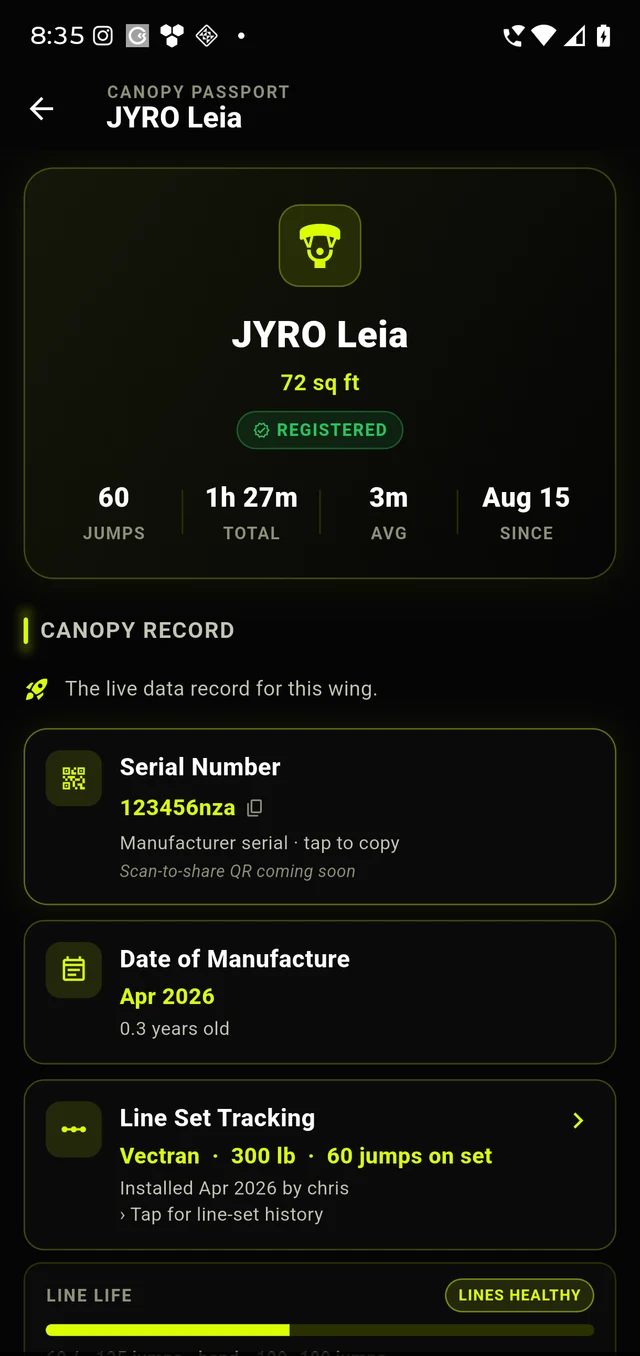
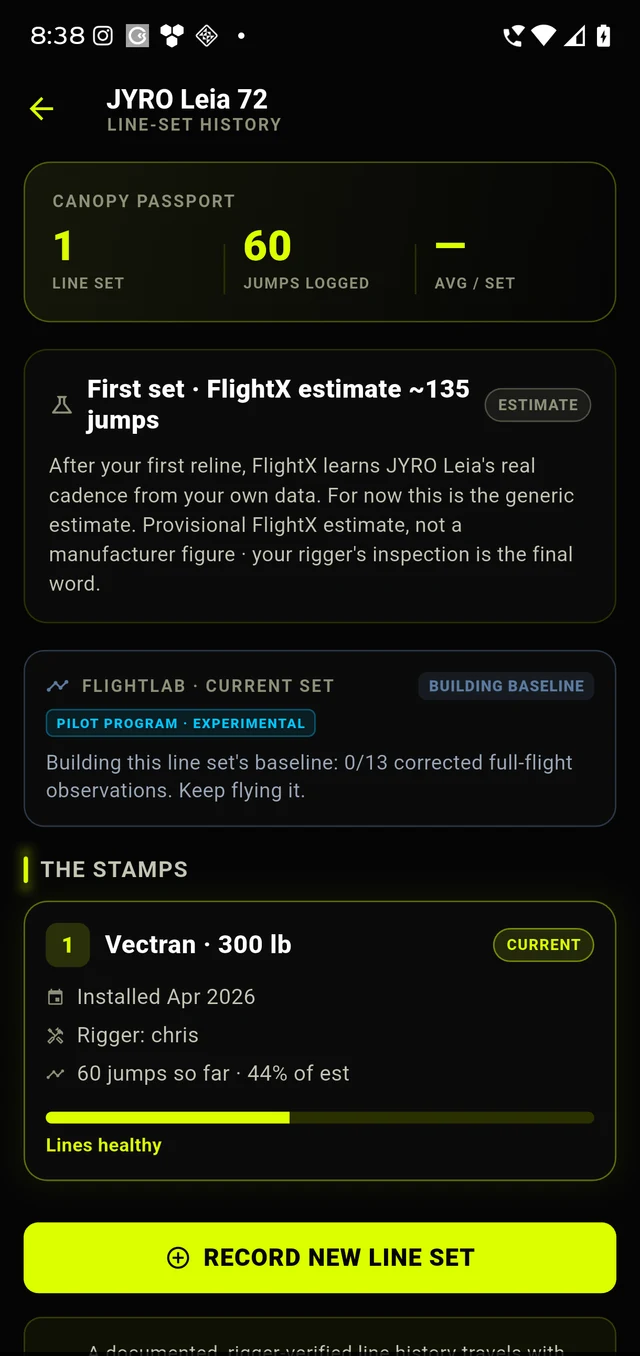
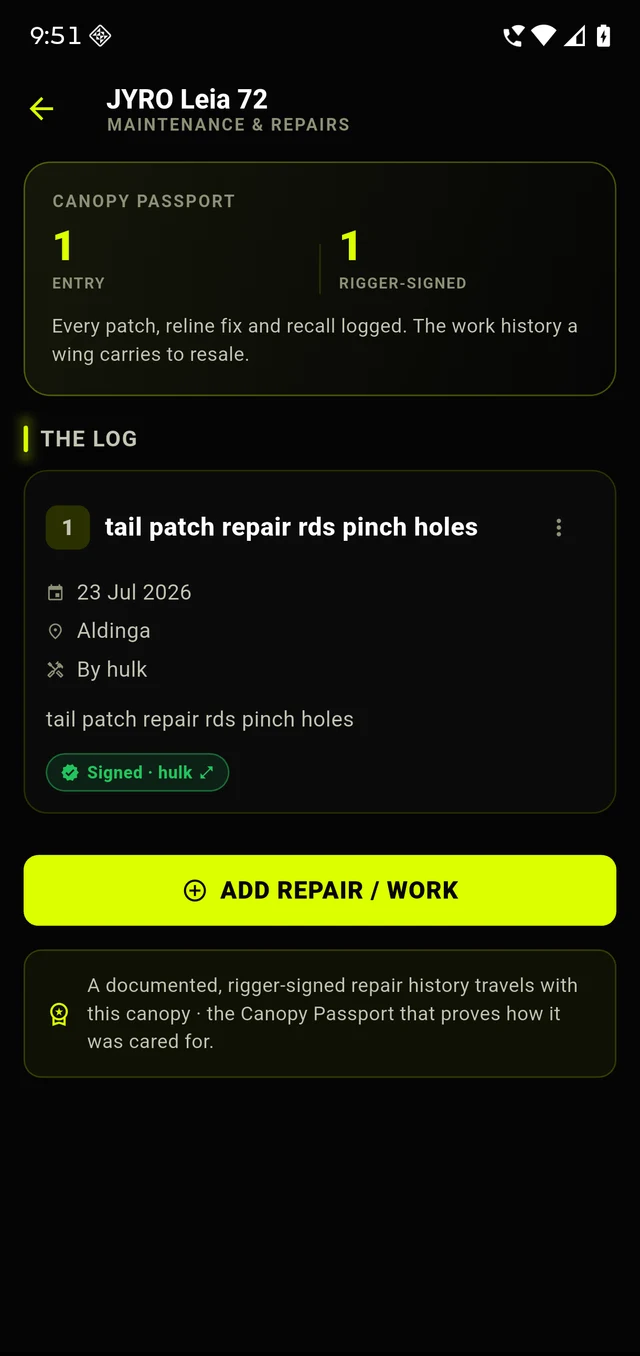
Note the serial on the first screen: you can read it because these are the owner's pages in their own app. It is blacked out on the advert a buyer reads, and the section below explains why. Rigger names sit against the entries the same way, visible to the owner and stripped when the record transfers to a new owner.
What FlightX witnessed
These are facts our own servers recorded. They are the ones worth paying for.
What the owner declared
These are the owner's words. They stay labelled as the owner's words, on every surface, permanently. A declared figure never quietly becomes a logged one.
The life of a wing
- 1Register
A wing joins the passport by serial, which is its permanent identity.
- 2Fly and log
Jumps and hours accrue against the wing every time it is flown with the app.
- 3Service and sign
Line sets and repairs are stamped, and a rigger signs the ones they did.
- 4Sell
A dated PDF snapshot of the passport rides on the Hangar Bay listing.
- 5Transfer
The service history follows the serial, not the seller. Personal data does not travel.
- 6Next pilot
The new owner inherits the wing’s whole mechanical life on day one, and keeps logging.
Identity severed by design: no names, no signatures and no personal data cross between owners. What travels is the wing's mechanical life.
Why the serial is blacked out
What this is not
What the passport does
- Keeps a wing's service and incident history in one place, keyed to the wing.
- Separates what FlightX recorded from what an owner typed, and says which is which.
- Carries a rigger's own signature on the repairs that rigger did.
- Shows gaps as gaps. An honest record with a hole in it is still worth more than a blank.
- Moves to the next owner so the history does not restart at zero.
What it is not
- Not an airworthiness certificate. A rigger with the gear in their hands is the only thing that can tell you a canopy is fit to jump.
- Not a FlightX verification of a repair. A rigger-signed entry is that rigger's attestation. We never claim we checked a canopy.
- Not a suitability call. Whether a wing suits you belongs with your coach and your rigger.
- Not a valuation. It tells you what happened to the wing, not what it is worth.
- Not proof of ownership. It is a service record, not a title.
Starting a passport
The record is built in the FlightX app, because that is what is with you on the drop zone when the jump happens and when the rigger signs. Register the wing once by serial, and the jumps, hours, line sets and repairs accrue from there. Selling it later on Hangar Bay is then one tap, because the history already exists.
A passport snapshot attaches when a seller lists a wing they fly with FlightX. Cards marked EXAMPLE are demonstrations, not gear for sale.